
On cyber in SvD
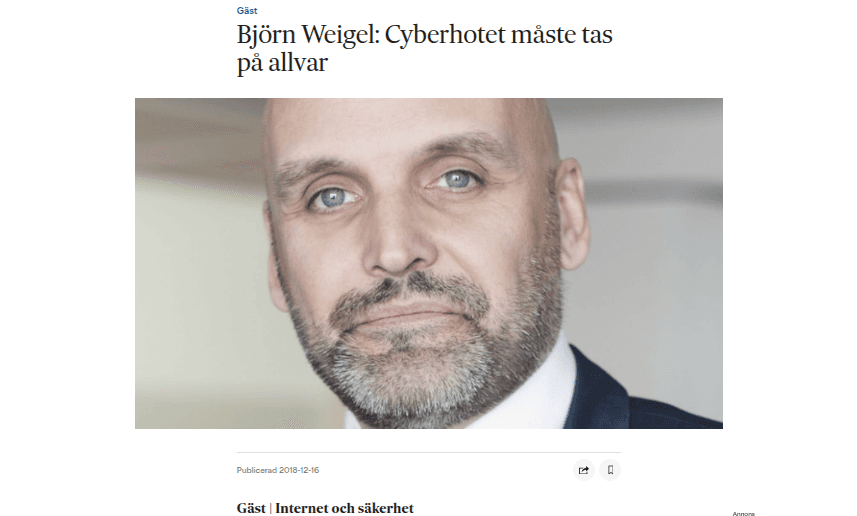
The Internet is fundamentally an anarchic system in which the benefits of digitalization are accompanied by growing cyber threats. These can be divided into three main categories: economic cyber espionage, cybercrime, and political warfare, which together affect states, businesses, and private individuals. The cyber threat is permanent and serious. Addressing it requires coordinated efforts between government and the business sector, education, and clear sanctions - without hindering economic development.
Read the entire editorial (in Swedish) here (link)
Or below translated into English:
Former Google CEO Eric Schmidt once observed that the internet is “…the largest experiment in anarchy we have ever had.” Digitalization is not solely a positive force; it also has a darker side. Actors who do not wish us well can hack anything connected to the internet and influence everything from companies, political elections, and personal identities to values and self-driving cars.
The map of the cyber threat landscape is fragmented but consists mainly of three parts: economic cyber espionage, cybercrime, and political warfare. Economic cyber espionage primarily affects companies and countries at the forefront of technological and economic development. As early as 2012, the head of the U.S. National Security Agency warned that cybercrime against American companies constituted “the greatest transfer of wealth in history.”
Europe is also affected. In 2016 alone, hacker attacks were carried out against around two-thirds of all German manufacturing and technology companies. Swedish companies are not spared either. According to government authorities, Sweden is subjected to tens of thousands of cyberattacks every month.
The second component, cybercrime, is a growing problem that increasingly affects private individuals and businesses. Just last week, the hotel chain Marriott announced that its reservation system had been hacked and that personal data from potentially 500 million customers had been stolen. At the same time, the popular Q&A site Quora reported that 100 million user accounts had been compromised. The share of malicious software targeting mobile phones increased by more than 50 percent in 2017, and so-called “cryptojacking”—the unauthorized use of others’ computers to generate cryptocurrencies such as Bitcoin - rose by a staggering 8,500 percent.
The third component of the cyber threat concerns political warfare. The U.S. presidential election was, as is well known, hacked in 2016, but digitalization has opened up additional avenues for illegitimate political influence and sabotage. In October 2018, the Dutch security service arrested officers from the Russian military intelligence agency GRU who were attempting to hack the Organisation for the Prohibition of Chemical Weapons (OPCW).
The Russian operation was likely linked to the accusations against Russia in connection with the nerve agent attack on Sergei Skripal and his daughter in the United Kingdom earlier that year. The sabotage of Iran’s nuclear program using the internet trojan Stuxnet already demonstrated in 2010 that real damage can be inflicted on heavily guarded physical systems through hacking methods.
Only through comprehensive and joint efforts to safeguard the integrity of society can the cyber threat be countered. This includes educational initiatives and more effective forums for cooperation between the private sector and policymakers, as well as robust measures against actors behind cyber threats - among them more extensive economic penalties for the theft of intellectual property.
All of this must also be achieved without hampering economic development. But the cyber threat is here to stay. Only by being prepared can we productively enter the next phase of digitalization.
You May Also Like

GET STARTED
Built Deliberately
We believe great companies are not optimized into existence.
They are formed deliberately — by people who know their craft, and who dare to do good with it.